The fastest speaker rarely has the only valuable idea in the room. I have facilitated sessions where one thoughtful comment from a quiet participant exposed a risk that an hour of confident discussion had missed.
Learning how to encourage quiet participants during facilitated meetings is not about persuading everyone to become more outspoken. It requires designing several safe, practical ways to contribute. A participant may think deeply, need processing time, dislike interruption, or prefer writing over spontaneous speech.
Why Quiet Participants May Hold Back
Silence does not automatically mean disengagement. Some people listen before speaking. Others hesitate because senior leaders, subject experts, or dominant personalities control the discussion.
A participant may also remain quiet when questions feel vague. “Does anyone have thoughts?” places a heavy cognitive burden on the group. People must interpret the question, create an answer, judge its value, and find an opening to speak.
Psychological safety also matters. The American Psychological Association reports that employees who experience greater psychological safety tend to report more positive workplace experiences. Facilitators influence that safety through the meeting structure, response style, and distribution of airtime.
I therefore treat silence as information about the environment, not a flaw in the individual.
Prepare for Inclusive Participation Before the Meeting
The work begins before anyone enters the room. Preparation reduces the advantage held by people who think quickly while speaking.
Share questions before the session
Send the agenda, desired outcome, and key questions at least 24 hours ahead when possible. Participants can then organize their thoughts, gather evidence, and identify concerns.
Do not send only a list of topics. Include focused prompts such as:
“What customer problem should this decision solve?”
“What risk could prevent this plan from working?”
“What information do we still need?”
Clear questions produce clearer contributions.
Offer more than one contribution channel
Tell attendees how they can participate. Options may include speaking, adding digital notes, using the chat, answering a poll, or sending a follow-up comment.
This approach is especially useful when a workshop examines a complex service ecosystem mapping exercise. Participants from operations, technology, customer support, and policy may see different dependencies. Written input lets each person contribute specialist knowledge without competing for the floor.
Assigning a defined role can also help. A quiet participant may feel more comfortable presenting data, reporting from a small group, or identifying unanswered questions. However, avoid repeatedly assigning administrative roles such as note-taking. That can reduce rather than increase their influence.
Use Structured Facilitation Methods During the Meeting

Strong facilitation replaces the open-floor free-for-all with predictable participation stages. This is central to how to encourage quiet participants during facilitated meetings without embarrassing anyone.
Begin with silent thinking
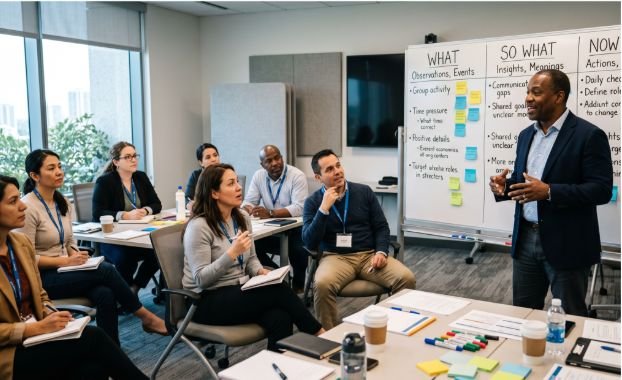
After presenting a question, give participants two to five minutes to write privately. Ask for one idea per note.
Silent thinking prevents the first speaker from anchoring everyone else’s response. It also gives reflective participants time to create a complete thought.
I use a simple instruction:
“Take two minutes. Write one concern, one opportunity, and one question. We will share after everyone has finished.”
Avoid talking during this period. Facilitators often become uncomfortable with silence and begin explaining the task again. That interruption steals the thinking time they intended to provide.
Apply the 1-2-4-All method
The 1-2-4-All structure moves participants through four stages: individual reflection, pairs, groups of four, and whole-group sharing. Liberating Structures describes it as a method that engages every voice and helps surface ideas people might otherwise keep to themselves.
A practical 15-minute version works like this:
- Think alone for one minute.
- Discuss in pairs for two minutes.
- Refine ideas in groups of four for five minutes.
- Share key insights with everyone for seven minutes.
The official structure uses roughly this timing. By the final stage, quieter contributors have tested their idea and gained support. They are no longer speaking into an uncertain room.
Use optional round-robin sharing
A round-robin gives each person an equal opportunity to respond. Keep answers short and state that passing is acceptable.
Try:
“We will go around once. Share one observation, or say pass if your point has already been covered.”
The option to pass protects autonomy. Without it, a structured invitation can feel like forced public performance.
Create Safer Verbal Invitations
Broad invitations usually attract the same confident voices. Specific prompts create a clearer entry point.
Instead of naming a quiet person unexpectedly, invite a perspective:
“We have heard the customer-facing view. What might the implementation team notice?”
“You have worked closest to this process. Is there a detail the group should consider?”
This gives relevant participants a reason to speak without labeling them as quiet.
After asking a complex question, wait. I silently count to ten before rephrasing or answering it myself. Someone often begins speaking around the seventh or eighth count.
When a less vocal participant contributes, acknowledge the substance rather than praising the act of speaking. Avoid saying, “Great, you finally spoke.” Instead say, “Your point about the approval delay changes how we should assess this option.”
Then ask a gentle follow-up:
“What evidence led you there?”
“What would address that concern?”
This validates the idea without placing the person under a spotlight.
Engage Quiet Participants in Virtual and Hybrid Meetings

Virtual meetings provide useful parallel channels, but facilitators must actively legitimize them.
Tell attendees that chat comments count as contributions. Pause regularly to read them aloud and connect them to the verbal discussion. Otherwise, chat becomes a secondary conversation with little influence.
Anonymous tools can reduce fear of judgment. Miro states that its Private Mode can reduce group bias and give participants privacy while they formulate ideas. Its voting feature also keeps individual votes anonymous.
Live polling works well for sensitive choices or rapid temperature checks. Mentimeter allows attendees to respond from a phone, tablet, or computer and displays results in real time. Its standard voting process is anonymous, which may encourage more honest input.
For hybrid meetings, avoid giving remote attendees one general invitation at the end. Alternate between room voices, remote voices, chat input, and written activities throughout the session.
Measure Participation Without Counting Who Talks Most
My most useful facilitation metric is not speaking time. It is the percentage of participants who contribute through at least one meaningful channel.
I call this the contribution-route check. After a session, I review four routes:
- Individual written input
- Pair or small-group discussion
- Whole-group verbal contribution
- Digital chat, polling, or follow-up feedback
Suppose 12 people attend. Only five speak during the full-group discussion, but ten add written ideas and all 12 contribute in pairs. The session may be more inclusive than a meeting where nine people speak briefly but only two shape the decision.
This distinction improves how to encourage quiet participants during facilitated meetings because it shifts the goal from visible performance to useful influence.
Common Mistakes Facilitators Should Avoid
Cold-calling is the most common mistake. It can produce an immediate answer, but it may increase anxiety and discourage future participation.
Do not ask a quiet attendee to represent an entire group. One engineer cannot speak for engineering, and one junior employee cannot represent every early-career worker.
Avoid filling every silence. Thinking time may feel awkward to the facilitator while remaining productive for participants.
Do not allow dominant speakers to respond first every time. Use phrases such as, “Let us hear two new voices before returning to previous contributors.”
Finally, never collect written or anonymous input and then ignore it. Participants quickly notice when alternative channels have no effect on the decision.
Frequently Asked Questions
1. How do you involve quiet people in group discussions?
Start with private reflection, move into pairs, and invite whole-group sharing only after participants have developed their ideas.
2. Should facilitators call on quiet participants directly?
Use advance notice or perspective-based invitations instead of sudden cold-calling, and always make passing acceptable.
3. How can virtual facilitators encourage quieter team members?
Use chat, anonymous polling, private digital notes, smaller breakout rooms, and pauses for individual thinking.
4. What is the best way to encourage introverts in meetings?
Provide questions early, allow processing time, create predictable speaking opportunities, and offer written alternatives to verbal participation.
Less Pressure, Better Ideas—That Is the Real Win
The question is not how to make every person talk equally. The better question is whether every participant has a fair route to influence the work.
That principle has shaped how to encourage quiet participants during facilitated meetings in my own sessions. I prepare questions early, begin with silent reflection, move ideas through small groups, and use whole-group speaking as only one participation channel.
At your next meeting, replace one open discussion with two minutes of silent writing followed by paired sharing. The change is small, but the voices you hear may change the decision.